
Why the Best Teams Are Built Outdoors, Not in Boardrooms
Walk into any office on Monday morning and you’ll probably see the same thing.
People sitting in meetings.
PowerPoint presentations.
Project updates.
Performance reviews.
Everything looks organized.
Yet many organizations still struggle with poor communication, lack of trust, workplace conflicts, and low employee engagement.
Why?
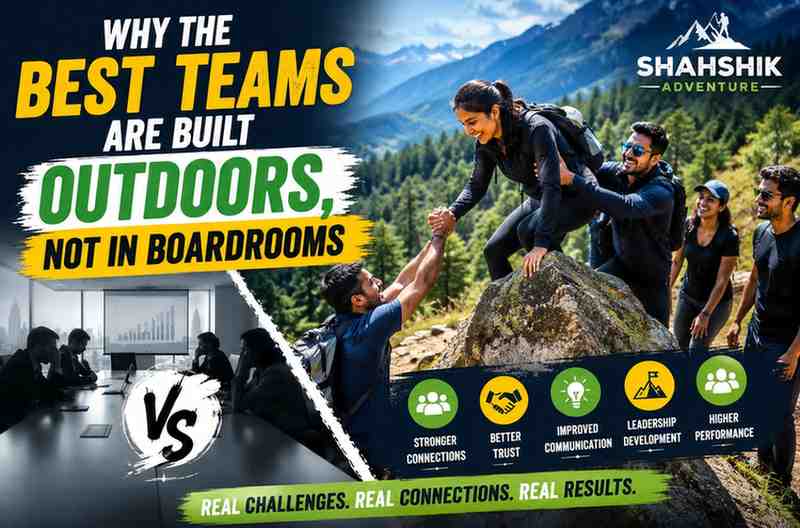
Because great teams are not built by sitting together—they are built by overcoming challenges together.
That is why many of the world’s most successful organizations are moving beyond conference rooms and investing in outdoor team-building experiences.
The strongest teams are rarely created inside four walls.
They’re built on hiking trails, rope courses, adventure camps, problem-solving challenges, and shared experiences that require people to rely on one another.
The Boardroom Has Its Limits
Meetings are essential.
Planning is important.
Strategy discussions matter.
But there is one thing a meeting cannot create overnight:
Trust.
Imagine asking a new employee,
“Do you trust your team?”
Most people will politely say yes.
But trust isn’t measured by words.
It’s measured by actions.
Would they trust a teammate to support them during a difficult project?
Would they ask for help without hesitation?
Would they openly admit a mistake?
These moments don’t happen naturally during presentations.
They happen through experiences.
Why Outdoor Experiences Build Stronger Teams
Outdoor activities remove the usual workplace hierarchy.
The CEO and the intern wear the same safety helmet.
The manager and the executive climb the same obstacle.
Job titles suddenly matter much less.
Instead, people begin to notice qualities that often stay hidden inside an office:
- Leadership
- Patience
- Creativity
- Communication
- Problem-solving
- Emotional intelligence
When a team faces an unfamiliar challenge together, everyone participates.
Everyone contributes.
Everyone learns.
Real Example: Google’s Team Culture
Google has long been recognized for building high-performing teams.
One of the most important findings from Google’s famous Project Aristotle was that the highest-performing teams were not necessarily made up of the smartest individuals.
Instead, the strongest predictor of success was psychological safety—a workplace where people feel comfortable sharing ideas, asking questions, and admitting mistakes without fear.
Outdoor team-building activities naturally encourage this kind of environment.
When employees solve challenges together outside the office, communication becomes more open, relationships grow stronger, and trust develops more naturally.
The lesson is simple:
Teams perform better when people feel connected—not just professionally, but personally.
Real Example: The Military Doesn’t Build Teams in Classrooms
Military organizations around the world spend months training soldiers together.
Why?
Because trust cannot be taught through lectures.
It develops through shared hardship.
Obstacle courses.
Navigation exercises.
Team missions.
Physical challenges.
No one succeeds alone.
While corporate offices are obviously very different from the military, the principle remains the same.
Shared challenges create stronger teams.
Example: Two Marketing Teams
Let’s compare two companies.
Team A
Every Friday they attend a one-hour meeting.
Everyone discusses targets.
The meeting ends.
Employees return to their desks.
Communication remains mostly formal.
Team B
Instead of another meeting, they attend a one-day outdoor team-building program.
They complete:
- Rope challenges
- Blindfold communication games
- Treasure hunt
- River crossing simulation
- Leadership rotation activities
At first, people struggle.
Some fail.
Some laugh.
Some step up as leaders.
By the end of the day, people know each other differently.
Back in the office, collaboration becomes easier because relationships have already been built.
That is the difference between knowing someone’s job title and knowing the person.
Adventure Creates Real Conversations
Inside an office, conversations often sound like this:
“Did you finish the report?”
“Can you send me the presentation?”
“What’s the deadline?”
Outside, conversations change.
“You’ve got this.”
“I’ll help you.”
“Let’s solve it together.”
These moments create emotional connections.
And emotional connections improve teamwork.
Outdoor Challenges Reveal Hidden Leaders
Many companies assume leadership belongs only to managers.
Adventure activities often prove otherwise.
The quiet employee who rarely speaks during meetings may become the strongest leader during a trekking expedition.
The newest employee may solve the toughest challenge.
Someone who usually avoids attention may become the team’s biggest motivator.
Outdoor environments reveal potential that office settings often hide.
The Science Behind Team Building
Research in organizational psychology consistently shows that shared experiences improve:
- Trust between colleagues
- Communication quality
- Employee engagement
- Collaboration
- Creative thinking
- Workplace morale
Outdoor learning also improves memory because people remember experiences far better than presentations.
Most employees forget a PowerPoint within days.
Few forget the day they climbed a mountain with their team.
Benefits of Outdoor Team Building
Better Communication
Employees learn to listen, explain clearly, and solve problems together.
Stronger Trust
Challenges encourage people to depend on one another.
Improved Leadership
Different activities allow different personalities to lead.
Higher Employee Engagement
People return to work feeling energized rather than exhausted.
Better Problem Solving
Adventure activities encourage creative thinking under pressure.
Reduced Workplace Stress
Nature has been shown to reduce stress and improve mental well-being.
Activities That Build Great Teams
A successful corporate adventure program may include:
- Trekking
- Rock Climbing
- Zipline Challenges
- Low Rope Courses
- High Rope Courses
- Obstacle Challenges
- Survival Games
- Team Treasure Hunts
- Leadership Challenges
- Problem-Solving Missions
- Campfire Reflection Sessions
Each activity develops a different workplace skill.
Who Should Participate?
Outdoor team-building is valuable for:
- Corporate Offices
- IT Companies
- Manufacturing Teams
- Sales Teams
- Educational Institutions
- Government Organizations
- Healthcare Teams
- Startups
- Hospitality Industry
- NGOs
Whether a company has 20 employees or 2,000, every organization benefits from stronger relationships.
How Often Should Companies Organize Team Building?
Many HR professionals recommend at least one major outdoor team-building event every year, supported by smaller engagement activities throughout the year.
Regular experiences help maintain momentum and strengthen workplace culture over time.
Why Companies Are Investing More in Adventure-Based Learning
Today’s workforce wants more than salaries.
Employees value:
- Purpose
- Connection
- Growth
- Recognition
- Positive workplace culture
Adventure-based learning supports all of these.
It creates experiences employees remember long after the event is over.
Boardrooms are where strategies are discussed.
But adventures are where trust is built.
The best teams aren’t simply the ones with the smartest people.
They’re the ones who communicate honestly, solve problems together, support one another during challenges, and celebrate success as a team.
That kind of culture cannot be created by another meeting alone.
Sometimes, all it takes is stepping outside.
Because the strongest teams are not built around a conference table.
They are built on shared adventures.
Ready to Build a Stronger Team?
At Shahshik Adventure, we design customized corporate team-building programs that combine adventure, leadership, collaboration, and fun. Whether you’re planning a one-day offsite, a leadership retreat, or a multi-day corporate adventure camp, our experienced facilitators create safe, engaging experiences tailored to your organization’s goals.
Let’s move beyond the boardroom and build teams that truly work together.