

Introduction
Today’s school education is mostly limited to classrooms, books, and exams. While academics are important, true learning goes beyond textbooks. This is where adventure learning plays a powerful role in shaping a child’s overall development.
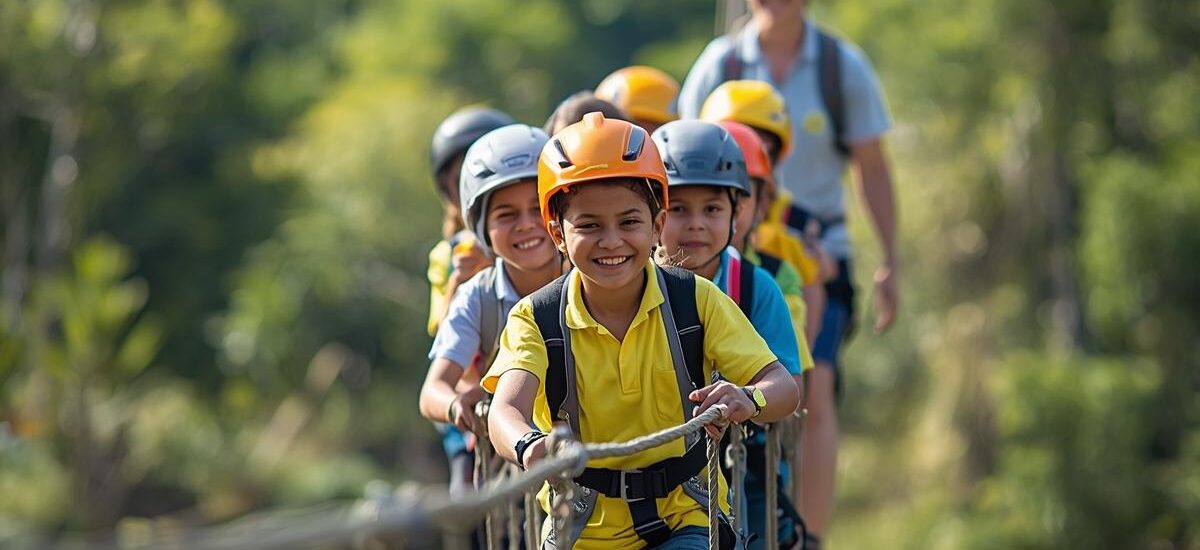
Adventure learning helps school students learn through experience, action, and real-life situations. Activities like rope courses, trekking, team games, and outdoor challenges make learning fun, practical, and memorable.
What Is Adventure Learning?
Adventure learning is a form of education where students learn through outdoor activities and challenges instead of only sitting in classrooms.
It includes:
- Outdoor games
- Adventure activities
- Team challenges
- Nature exploration
- Experiential learning programs
The goal is not just fun, but building life skills in students.
Why Adventure Learning Is Important for School Students
1. Builds Confidence and Self-Belief
When students complete an adventure activity, they feel proud of themselves.
Crossing a rope bridge or finishing a challenge teaches them:
- “I can do it”
- “I am stronger than I think”
This boosts self-confidence, which helps students perform better in studies and life.
2. Improves Physical and Mental Health
Adventure learning involves movement, fresh air, and physical activity. This helps students:
- Stay active and healthy
- Reduce stress and screen time
- Improve focus and energy
A healthy body supports a healthy mind.
3. Develops Teamwork and Communication Skills
Most adventure activities are group-based. Students learn how to:
- Work together
- Communicate clearly
- Respect others’ ideas
- Support teammates
These skills are essential not only in school, but also in future careers.
4. Encourages Problem-Solving and Critical Thinking
Adventure challenges often have no single solution.
Students must think, plan, and act together.
This improves:
- Decision-making skills
- Logical thinking
- Creativity
- Leadership abilities
Learning becomes practical, not theoretical.
5. Reduces Fear and Builds Courage
Many students are afraid of failure or making mistakes.
Adventure learning teaches them that:
- Failure is part of learning
- Trying is more important than winning
- Fear can be overcome
This mindset helps students face exams, competitions, and real-life challenges.
6. Learning Becomes Fun and Memorable
Students remember experiences longer than lectures.
Adventure learning turns education into an exciting journey, not a boring routine.
When learning is fun:
- Students participate actively
- Interest in studies increases
- School life becomes enjoyable
7. Supports Overall Personality Development
Adventure learning helps in:
- Leadership development
- Discipline and responsibility
- Emotional strength
- Social interaction
It prepares students for real-world situations, not just exams.
Adventure Learning vs Traditional Classroom Learning
| Traditional Learning | Adventure Learning |
|---|---|
| Book-based | Experience-based |
| Mostly theory | Practical learning |
| Limited interaction | High student involvement |
| Exam-focused | Skill and growth-focused |
Both are important, but adventure learning completes education.
Best Adventure Learning Activities for School Students
- Rope courses
- Obstacle challenges
- Team-building games
- Nature walks
- Trekking
- Problem-solving activities
- Digital Dome Planetarium learning
These activities are safe, supervised, and designed for different age groups.
Role of Schools in Promoting Adventure Learning
Schools should include:
- Educational tours
- Outdoor learning days
- Adventure camps
- Experiential learning programs
This helps students grow into confident, responsible, and capable individuals.
Conclusion
Adventure learning is not a luxury—it is a necessity for modern education.
It helps school students grow physically, mentally, socially, and emotionally.
By combining classroom education with adventure learning, schools can create future-ready students who are confident, skilled, and fearless.
Learning should not stop at the classroom door — it should begin with experience.
FAQs – Adventure Learning for School Students
Q1. Is adventure learning safe for school students?
Yes. Activities are conducted with safety equipment and trained instructors.
Q2. At what age can students start adventure learning?
Adventure learning can start from primary school with age-appropriate activities.
Q3. Does adventure learning help in academics?
Yes. It improves focus, confidence, and problem-solving skills, which support academic performance.
Q4. How often should schools organize adventure learning programs?
At least once or twice a year for balanced development.