

Introduction
For a long time, astronomy has been one of those subjects that students read about but rarely experience. Books show diagrams, teachers explain concepts, and students try to imagine how space actually looks.
But let’s be honest — imagining something as vast as the universe is not easy.
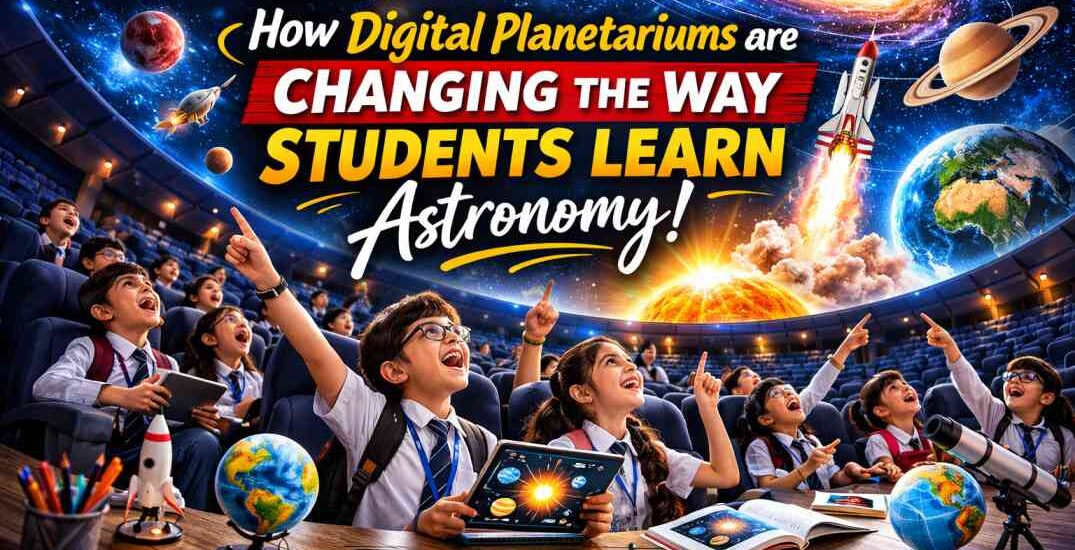
Today, things are changing. With the rise of digital planetariums, students are no longer limited to textbooks. They can now see and feel what they are learning.
This shift is slowly changing the way students understand astronomy.
India’s Best Adventure Company for School Adventure Camps & Experiential Learning
Learning Beyond the Classroom
Traditional classrooms have their limits. A teacher can explain planets, stars, and galaxies, but there is only so much that can be shown on a board or a screen.
Digital planetariums take students out of that limitation.
Inside a dome, the entire space becomes a learning environment. Instead of small images, students see the universe around them. The scale, the movement, and the details make everything clearer.
It is no longer just theory — it becomes an experience.
Visual Learning Makes a Big Difference
Every student learns differently. Some understand through reading, some through listening, and many through seeing.
Astronomy, especially, becomes much easier when it is visual.
When students watch planets moving in real time or see how galaxies are formed, concepts that once felt complicated suddenly become simple.
They don’t have to imagine anymore — they can see it happening.
Family Adventure Trips by Shahshik Adventure – Bond Without Screens
Better Understanding of Complex Concepts
Topics like black holes, gravity, or the structure of the universe can feel confusing when explained only with words.
In a digital planetarium, these concepts are shown step by step.
Students can watch how a black hole pulls objects, how planets orbit the sun, or how stars are born and die.
This clarity helps students understand faster and remember for longer.
Increased Interest in Science
One of the biggest challenges in education is keeping students interested.
When learning feels boring, attention drops. But when learning feels exciting, students naturally become curious.
Digital planetariums make learning enjoyable.
Students don’t feel like they are studying. Instead, they feel like they are exploring. This change in mindset increases their interest in science and encourages them to ask questions.
Encouraging Curiosity and Questions
After experiencing a digital planetarium, students often leave with more questions than answers — and that is a good thing.
They start thinking:
-
How big is the universe?
-
Are there other planets like Earth?
-
What exists beyond our galaxy?
This curiosity is the foundation of real learning.
It pushes students to explore more, read more, and understand deeper.
A Modern Approach to Education
Education is evolving. Schools are now focusing more on practical and experience-based learning rather than just theory.
Digital planetariums fit perfectly into this approach.
They combine:
-
Technology
-
Visual storytelling
-
Scientific accuracy
This makes them a powerful tool for modern education.
Why Schools Are Choosing Digital Planetariums
Many schools are now including digital planetarium visits in their educational trips.
The reason is simple — students learn better when they experience things.
Benefits for schools include:
-
Higher student engagement
-
Better concept clarity
-
A unique learning experience outside the classroom
It also gives students a break from routine learning while still adding value.
A Real Impact on Memory and Understanding
Students often forget what they read after a few days. But experiences stay in memory.
When a student sees the Milky Way above them or watches planets move around, it creates a strong impression.
This kind of learning is not easily forgotten.
It becomes a memory, not just information.
Digital Dome Planetarium in India: A New Way to Explore the Universe
The Role of Shahshik Adventure
In India, places like Shahshik Adventure are helping bring this modern learning experience to students.
Their digital dome planetarium is designed not just for entertainment, but for meaningful learning.
Students who visit don’t just watch a show — they go through an experience that helps them understand space in a simple and engaging way.
The Future of Astronomy Learning
The way students learn is changing, and digital planetariums are becoming an important part of that change.
As technology improves, these experiences will become even more realistic and interactive.
In the future, students may not just watch space — they may interact with it.
And that will make learning even more powerful.
Frequently Asked Questions (FAQ)
1. What is a digital planetarium?
A digital planetarium is a dome-based theatre that uses 360-degree projection to display space and astronomy visuals in an immersive way.
2. How does it help students learn astronomy?
It helps by showing real-time visuals of space, making complex concepts easier to understand and remember.
3. Is it better than classroom learning?
It does not replace classroom learning but enhances it by adding a real experience to theoretical knowledge.
4. Can young students understand the content?
Yes, the content is designed in a simple and visual way, making it easy for students of all ages to understand.
5. Are digital planetariums available in India?
Yes, they are available in selected locations, including experiences offered by Shahshik Adventure.
6. Do schools organize visits to digital planetariums?
Yes, many schools organize trips because it improves engagement and understanding among students.
Astronomy is no longer limited to textbooks and imagination.
With digital planetariums, students can now experience what they learn. They can see, feel, and understand space in a way that was not possible before.
This shift is not just improving learning — it is making it more meaningful.
And as more students get access to such experiences, the way we teach and learn astronomy will continue to evolve.